Skip to content




An authentic handloom Madhubani saree should have clearly described fabric, credible handloom construction, detailed Madhubani artwork, and transparent information about its making. Check the weave, artwork, motifs, fabric composition, seller credentials, and provenance before buying. Do not rely on price or the word “handloom” alone.
An authentic handloom Madhubani saree combines skilled textile craftsmanship with the distinctive visual language of Madhubani art. Check the fabric, weave, artwork, product details, and seller credibility before purchasing. At WeaverStory, we celebrate India's rich textile traditions through thoughtfully crafted clothing. Before you choose your next saree, here is what deserves a closer look.
What Is an Authentic Handloom Madhubani Saree?
Madhubani, also known as Mithila art, is a traditional painting tradition associated with the Mithila region of Bihar. It is recognised for intricate line work, symbolic motifs, geometric details, and compositions inspired by nature, mythology, and cultural life. The art has evolved from traditional surfaces to contemporary applications, including textiles.
Handloom and Madhubani describe two different aspects of a saree. Handloom refers to the way the textile is woven, while Madhubani refers to the artistic tradition represented on it. A saree can therefore feature handwoven fabric and hand-painted artwork, but these two qualities should be evaluated separately.
That distinction is important when searching for an authentic handloom Madhubani saree. A product labelled “Madhubani” is not automatically hand-painted, and a handloom saree is not automatically decorated with authentic Madhubani artwork.
How to Identify an Authentic Handloom Madhubani Saree
1. Check Whether the Saree Is Actually Handwoven
Begin with the textile rather than the artwork. Examine the weave, selvedge, texture, and overall finish. Handwoven fabrics can show subtle variations created during weaving, although variation by itself is never conclusive proof of authenticity. If you want to understand these construction signals in more detail, our guide on handloom vs power loom sarees explains how to tell the difference.
Ask for the exact fabric composition instead of relying on descriptions such as “silk finish” or “premium fabric.” If a product is described as silk, its material details should be clearly stated.
For a handloom Madhubani saree, the fabric description, weave and overall construction should make sense together.
2. Examine the Madhubani Artwork Closely
The artwork is one of the most important things to examine when buying an original Madhubani saree.
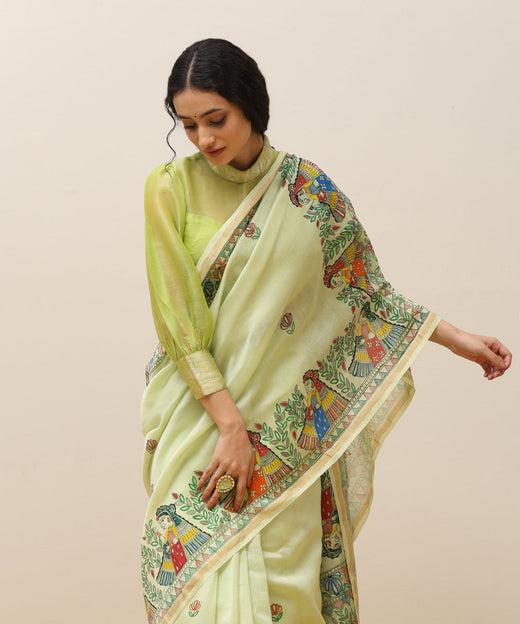
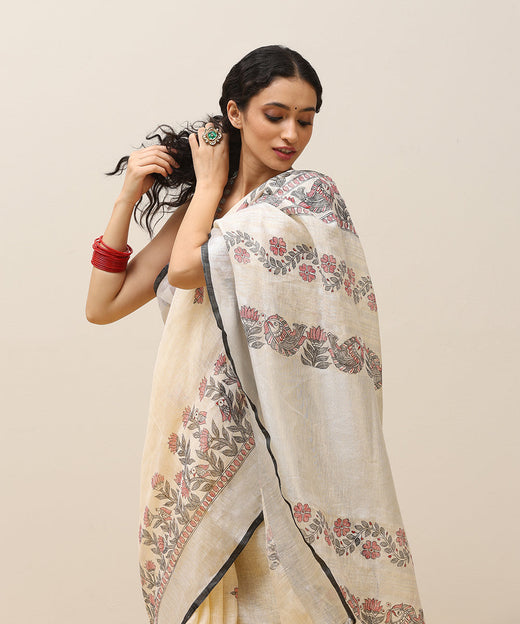
Traditional Madhubani compositions are known for detailed line work and motifs associated with nature, mythology and cultural symbolism. Common visual elements include fish, peacocks, lotus flowers, the sun, moon, plants, animals and narrative scenes.
Look closely at repeated motifs. Hand-created artwork can contain small differences in line thickness, spacing and colour application. A pattern that is perfectly identical throughout may indicate a printed reproduction rather than individually created artwork.
3. Turn the Saree Over and Inspect the Reverse
The reverse side can provide useful clues about how artwork has been applied.
Depending on the fabric, pigment and painting technique, hand-applied colour may show some penetration or variation through the weave. A printed design can have a noticeably more uniform reverse.
However, do not treat colour bleed as a standalone authenticity test. Different materials and techniques behave differently. Use this observation together with the weave, artwork, fabric information and seller details.
4. Inspect the Selvedge, Weave and Finishing
Look carefully at the edges and construction of the saree. A well-made textile should have a clearly finished selvedge and a weave consistent with the stated fabric.
The overall product should tell a consistent story. If the description claims handwoven silk but the seller provides vague material information and generic photographs, ask questions before purchasing.
This is particularly useful when comparing a Madhubani handloom saree with mass-produced alternatives.
5. Verify the Fabric Before Assuming It Is Silk
Search terms such as “Madhubani silk saree original” can create confusion because Madhubani describes an art tradition, not one specific fabric.
Madhubani artwork can be presented on different textiles, so always check:
-
Exact fibre or fabric composition
-
Weave description
-
Saree length and width
-
Care instructions
-
Product specifications
-
Relevant certification or documentation, where applicable
A seller should make it easy to understand exactly what you are buying.
6. Check Provenance and Seller Transparency
A trustworthy seller should be able to explain the fabric, artwork technique and product details clearly. Look for:
-
Detailed product descriptions
-
Clear, close-up photographs
-
Seller contact information
-
Customer reviews
-
Return or exchange policies
-
Information about craftsmanship
-
Artisan or regional information where available
Relevant marks or certifications can provide additional information, but buyers should always check what a particular certification actually covers.
7. Never Judge Authenticity by Price Alone
Price is useful as a warning signal, but it cannot prove authenticity.
A higher price can reflect premium fabric, intricate artwork, skilled labour, detailed finishing and the time involved in creating the piece. A very low price may indicate a printed or mass-produced product, but low price alone is not definitive proof.
The best approach is to evaluate price alongside materials, craftsmanship and transparency.
Original Madhubani Saree vs Machine-Printed Lookalike
|
Feature |
Handcrafted Piece |
Printed Lookalike |
|
Artwork |
Natural variation and detailed craftsmanship |
Highly uniform reproduction |
|
Repeated motifs |
Small differences may appear |
Often identical |
|
Fabric information |
Clearly stated |
May be vague |
|
Craft process |
Explained by seller |
Often unclear |
|
Provenance |
May include artisan or regional details |
Usually limited |
The goal is not to dismiss every printed saree. Printed Madhubani-style textiles can be attractive and affordable. The important thing is to understand whether you are paying for hand-created artwork, handloom craftsmanship, or a printed interpretation.
Red Flags When Buying a Madhubani Saree Online
Be more cautious when:
-
The fabric composition is not clearly stated.
-
“Handmade” or “handloom” is used without explaining the process.
-
Product photographs show only distant views.
-
The artwork technique is not mentioned.
-
The seller cannot answer basic questions about the textile.
-
Return, exchange or contact information is difficult to find.
-
The claimed craftsmanship seems inconsistent with the price.
-
Every product appears to use exactly the same artwork.
These checks are especially important when searching for a handmade Madhubani painting saree online, where a photograph alone may not reveal whether the design was painted or printed.
How to Buy an Authentic Madhubani Saree Online
Use this four-step process before placing your order.
Step 1: Read the Complete Product Description
Check the fabric, weaving method, artwork technique, measurements, origin information and care instructions.
Step 2: Study the Photographs
Zoom in on the pallu, border, motifs and fabric texture. Look for close-up images that allow you to assess the artwork rather than relying on one styled photograph.
Step 3: Verify the Seller
Look for a transparent brand presence, customer feedback, contact details and clearly stated policies.
Step 4: Ask Questions
Before purchasing, ask:
-
Is the saree handwoven?
-
Is the Madhubani artwork hand-painted or printed?
-
What is the exact fabric composition?
-
Is artisan or provenance information available?
-
What care method is recommended?
A seller who understands the product should be able to answer these questions clearly.
Authenticity Checklist Before You Buy
Use this quick checklist when evaluating an authentic handloom Madhubani saree:
-
Fabric composition is clearly stated.
-
Weaving method is disclosed.
-
Artwork technique is explained.
-
Product photographs show sufficient detail.
-
Seller information is transparent.
-
Relevant certifications are identified where applicable.
-
Saree dimensions are provided.
-
Care instructions are available.
-
Return or exchange terms are visible.
-
The price makes sense for the stated materials and craftsmanship.
If a seller cannot clearly explain the fabric, weaving method, artwork process and product details, investigate further before buying.
Why Authentic Madhubani Sarees Are Worth Choosing
A genuine handcrafted saree brings together textile skill and visual storytelling. Madhubani art has strong cultural associations with Mithila and is recognised for its intricate motifs and detailed compositions.
Choosing a well-documented piece also helps distinguish traditional craftsmanship from mass-produced imitations. The value lies not only in the finished drape but also in the skill, design knowledge, material and work that go into creating it.
For buyers who appreciate Indian craft, an original Madhubani saree can become more than occasion wear. It can be a distinctive expression of textile heritage.
How to Choose the Right Madhubani Saree for the Occasion
For weddings and festive celebrations, silk or Tussar options with detailed artwork can create a statement look. For daytime events, lighter fabrics and less densely decorated designs can feel easier to wear.
For collectors and heritage-focused buyers, pay closer attention to provenance, technique, fabric quality and the story behind the artwork. A distinctive handcrafted piece can offer more character than a perfectly repeated print.
How to Care for Your Madhubani Saree
Care should always follow the specific fabric and artwork instructions provided with your saree.
As a general practice:
-
Avoid harsh detergents.
-
Protect painted areas from unnecessary rubbing.
-
Keep the saree away from prolonged direct sunlight. If your saree is silk, our guide on how to store silk sarees covers folding and protection in more detail.
-
Follow professional cleaning advice when recommended.
-
Handle delicate artwork carefully during folding and storage.
The right care routine helps protect both the textile and its artwork over time.
What Makes WeaverStory a Thoughtful Choice?
WeaverStory focuses on Indian textile heritage, artisan craftsmanship and traditional techniques. Its approach allows shoppers to explore handcrafted Indian clothing while appreciating the textile traditions behind each piece.
If you are drawn to the richness of Indian silk and handcrafted detailing beyond sarees, the collection includes pieces such as Peach Handloom Pure Katan Silk Kurta With Raw Silk Pants And Organza Dupatta, Emerald Green Pure Mulberry Silk Suit Set, Purple Mulberry Silk Short Kurta and Gharara Set, and Bright Pink Pure Silk Hand Embroidered Kurta Set With Zardozi Silk Dupatta.
These pieces offer another way to experience the elegance of handcrafted Indian textiles while building a wardrobe rooted in traditional craftsmanship.
Discover Handcrafted Indian Elegance with WeaverStory
Looking beyond a saree for the same appreciation of Indian craftsmanship? Explore WeaverStory's handcrafted collection and discover pieces such as Offwhite Pure Silk Anarkali with Churidar, Red Pure Mulberry Silk Kurta with Churidar, and Purple Pure Silk Suit with Hand Embroidered Dupatta.
From handloom textiles to intricate embroidery, thoughtful craftsmanship remains at the heart of a wardrobe that values heritage, artistry, and timeless Indian elegance.
FAQs
Q1. How can I identify an original Madhubani saree?
Check the artwork, fabric, weave, product details, and seller transparency together. Look for detailed motifs, natural artistic variation, clear fabric composition and credible information about the craft process.
Q2. Can a Madhubani saree be handloom but not hand-painted?
Yes. Handloom describes the weaving method, while Madhubani describes the art. A handwoven saree can carry printed artwork, so check both claims separately.
Q3. Is every Madhubani saree made from silk?
No. Madhubani artwork can appear on different textiles, including cotton and silk. Always check the stated fabric composition rather than assuming that Madhubani means silk. If you are deciding between the two, our silk vs cotton saree comparison breaks down the practical differences.
Q4. Will an authentic Madhubani saree have perfectly identical motifs?
Not necessarily. Hand-created artwork can show subtle differences in line work, spacing, and colour application. Perfect repetition may suggest printing, but it should be considered alongside other evidence.
Q5. What should I check before buying a Madhubani silk saree online?
Check the fabric composition, artwork technique, photographs, measurements, seller information, care instructions, policies, and any relevant certification or provenance details.
Q6. Why are authentic Madhubani sarees more expensive?
The price can reflect fabric quality, weaving, artwork complexity, artisan time, skill, and finishing. Price alone does not prove authenticity, but an unusually low price deserves closer investigation.
Q7. How do I tell a handmade Madhubani painting saree from a printed one?
Examine repeated motifs, line variation, artwork detail, fabric information, and the reverse side where possible. Also ask the seller directly whether the artwork is hand-painted or printed.
Q8. Can I buy an authentic Madhubani saree online?
Yes. Choose sellers that provide clear product details, credible photographs, transparent policies and meaningful information about the textile and artwork process.