Skip to content




Madhubani painting is a traditional folk-art form from the Mithila region of Bihar, known for bold outlines, vivid colours, intricate patterns and motifs inspired by nature, mythology and daily life. On sarees, artisans carefully draw these motifs on handwoven fabric, fill them with colour, and add detailed patterns by hand.
Madhubani painting is a traditional Mithila art form that has evolved from painted walls and floors to paper, textiles and sarees. A Madhubani painting saree turns this detailed folk art into wearable textile art through careful hand-drawing, colouring and pattern work. At WeaverStory, this heritage comes alive through artisan-crafted sarees that connect tradition with contemporary elegance. So, how does the process actually work?
What Is Madhubani Painting?
Madhubani painting is a traditional art form associated with the Mithila region of Bihar. It is also widely known as Mithila painting. The art is recognised for its strong lines, vibrant colours, intricate patterns and compositions inspired by nature, mythology, religious themes and everyday life. Traditionally, the artwork was created on walls and floors, particularly around festivals and important occasions. It later expanded to paper, canvas and textiles.
One of the defining characteristics of Madhubani painting is the way artisans use lines and patterns to fill the composition. Instead of relying heavily on realistic shading, traditional works often use flat areas of colour surrounded by detailed outlines and decorative elements.
This distinctive visual language makes the art especially suited to textiles. A saree offers a long, flowing canvas where an artisan can create borders, pallu designs, individual motifs or compositions across the body.
Why Is It Also Called Mithila Painting?
Madhubani and Mithila painting are commonly used to describe the same broader artistic tradition associated with the Mithila region. “Mithila painting” connects the art directly with its cultural geography, while “Madhubani painting” became widely recognised through the association with Madhubani district and the art's growing visibility beyond the region.
This connection is important when understanding a Mithila painting saree because the saree is not simply decorated with attractive motifs. It carries a visual tradition rooted in the culture of Mithila.
What Is the Origin of the Madhubani Saree?
The Madhubani saree origin can be understood through the evolution of Mithila's traditional wall and floor art into textile-based forms. Women in the region traditionally decorated domestic spaces with paintings made during festivals, weddings and other significant occasions. Over time, the artistic vocabulary moved beyond walls and became part of portable art forms.
This transition allowed the motifs, colours and storytelling elements of the tradition to appear on paper and fabric. Sarees became a particularly expressive medium because their borders, pallus and broad body sections provide space for intricate artwork.
The move from walls to fabric did not simply change the surface. It transformed the artwork into something that could accompany the wearer, making traditional imagery part of everyday and ceremonial dressing.
What Makes Madhubani Art Unique?
Several visual characteristics help distinguish Madhubani art from other Indian folk-art traditions.
Bold Lines and Intricate Patterns
Madhubani compositions often begin with clear outlines. The spaces within and around the main figures are then filled with fine lines, dots, geometric patterns or repeated decorative elements.
The result is a highly detailed surface where even small areas contribute to the overall composition.
Nature-Inspired Motifs
Nature is a recurring source of inspiration. Common motifs include:
-
Fish
-
Peacocks
-
Elephants
-
Lotus flowers
-
Trees and plants
-
Birds and animals
-
Sun and moon
-
Floral patterns
These motifs can carry cultural and symbolic associations, although their meaning can vary according to the artistic context.
Mythological and Cultural Themes
Religious and mythological subjects also feature prominently in traditional Madhubani compositions. Figures and stories associated with Hindu traditions may appear alongside flowers, animals, trees and other elements of nature.
This combination of storytelling and decoration gives a Madhubani art saree its distinctive character.
What Is a Madhubani Painting Saree?
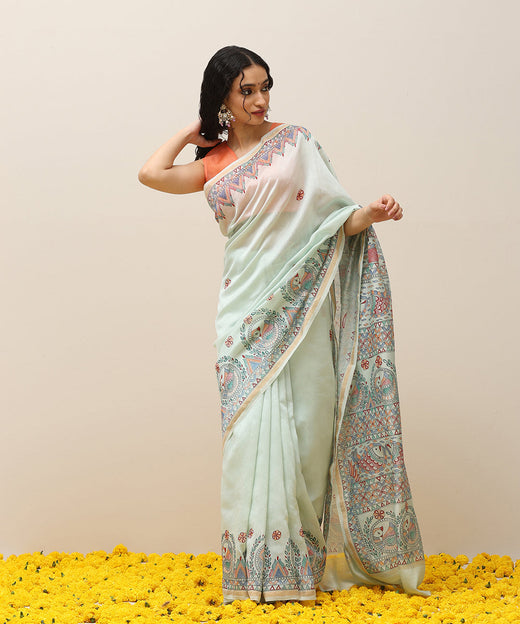
A Madhubani painting saree is a saree decorated with Madhubani-inspired artwork, often through detailed hand-painting. Instead of treating the fabric as a simple background, the artisan uses it as a canvas.
The artwork may appear:
-
Along the saree border
-
Across the pallu
-
On selected sections of the body
-
Through repeated motifs
-
As a continuous narrative composition
A hand-painted saree also carries the individuality of the artisan's work. Small variations in lines, colour application and detailing are natural characteristics of handmade art.
Hand-Painted vs Printed Madhubani Sarees
The difference is primarily in how the artwork reaches the fabric.
|
Hand-Painted |
Printed |
|
Artwork is created by an artisan |
Artwork is reproduced mechanically or digitally |
|
Small variations may occur |
Repeated designs tend to look more uniform |
|
Requires considerable manual work |
Usually faster to reproduce |
|
Each piece can have individual character |
Designs can be produced in larger quantities |
A printed saree can borrow the visual language of Madhubani art, while a hand-painted saree involves an artisan physically creating the artwork on the textile.
How Is Madhubani Painting Done on Sarees?
Creating Madhubani painting on saree requires planning, control and patience. The exact process can vary between artisans and designs, but the fundamental stages remain focused on preparing the fabric, creating the composition, outlining the motifs, applying colour and completing the fine details.
1. Selecting and Preparing the Fabric
The process begins with a suitable textile. Handwoven fabrics such as linen, Chanderi and Tussar can provide distinctive surfaces for Madhubani artwork.
The fabric's texture, weight and drape influence how the final artwork looks. WeaverStory's collection includes hand-painted Madhubani designs on handwoven linen and Chanderi, while its collection also features Tussar and cotton options.
2. Planning the Composition
Before the detailed artwork begins, the artisan plans how the design will occupy the saree.
A border may carry repeated motifs, while the pallu can accommodate a more elaborate composition. Some designs focus on a small number of prominent motifs, while others use numerous elements to create a densely decorated surface.
This planning stage is important because a saree is a long, moving textile rather than a stationary wall or sheet of paper.
3. Drawing the Motifs
The artisan then begins creating the artwork directly on the fabric.
Fine nibs and bamboo sticks can be used to outline traditional motifs. The initial lines establish the structure of figures, flowers, animals and other elements before colour and internal detailing are added. WeaverStory describes this outlining stage as part of the hand-painted process used for its Madhubani sarees.
The precision of these lines matters. They provide the framework that keeps the composition visually balanced.
4. Filling the Designs With Colour
Once the outlines are established, the motifs are filled with colour.
Traditional Madhubani art has a strong association with natural and mineral-based colour traditions. Materials such as turmeric, indigo and plant-based substances have historically been used to create colours. The Government of Bihar describes the traditional practice of using natural materials and applying colours in characteristic flat areas.
Contemporary textile practices can vary, so the colours used on every modern saree should not automatically be assumed to follow exactly the same traditional formulation.
5. Adding Fine Patterns and Details
The artwork becomes more distinctive as the artisan adds internal patterns.
Fine lines, dots, geometric forms, floral details and repeated motifs can fill the spaces inside larger figures. This detailed surface treatment is one reason a Madhubani painting saree can appear intricate even when its main composition contains only a few large motifs.
The detailing also creates rhythm across the fabric, allowing the artwork to remain visually engaging when the saree is draped.
6. Completing and Checking the Artwork
The final stage involves completing the remaining motifs and ensuring that the artwork feels balanced across the saree.
The amount of time required depends on the complexity and coverage of the design. WeaverStory states that its Madhubani sarees can take days, and sometimes weeks, to complete.
That time investment is an important part of understanding why hand-painted textile art differs from mass-produced printed designs.
Which Fabrics Are Used for Madhubani Sarees?
The choice of fabric changes the overall appearance and feel of the finished saree. If you want a broader overview of how saree fabrics differ, our guide to the different types of saree fabric is a useful starting point.
Chanderi
Chanderi offers a lightweight, elegant base for detailed artwork. Its delicate appearance pairs naturally with fine Madhubani motifs and intricate borders.
Linen
Linen brings a more textured and contemporary character. It works particularly well for understated designs where the fabric itself contributes to the aesthetic.
Tussar Silk
Tussar provides a naturally textured silk surface with a distinctive sheen. It gives traditional artwork a richer and more festive character.
Cotton
Cotton can offer a comfortable option for those who want traditional artwork in a lighter, more relaxed format.
WeaverStory's current collection includes Madhubani designs across linen, Chanderi, Tussar and cotton fabrics.
Which Motifs Are Commonly Found on a Madhubani Art Saree?
Motifs are more than decorative fillers. They form an important part of the visual vocabulary of the tradition.
-
Peacocks can introduce movement and ornamental beauty into a composition.
-
Fish are frequently used in Mithila-inspired artwork and are associated with themes such as fertility and prosperity in traditional interpretations.
-
Elephants can create a strong, majestic presence within a border or central composition.
-
Lotus and floral motifs bring natural forms and rhythmic patterns into the artwork.
-
Trees, birds and other nature-inspired elements reinforce the close relationship between Madhubani art and the natural world.
WeaverStory's collection includes designs featuring peacocks, fish, elephants and floral imagery.
How Can You Identify a Hand-Painted Madhubani Saree?
When shopping for a hand-painted saree, look beyond the overall print-like appearance.
Check for:
-
Fine, manually created line work
-
Detailed internal patterns
-
Natural variations in motifs
-
Clearly described artisan craftsmanship
-
Information about the fabric and painting process
-
A transparent description of whether the saree is hand-painted or printed
A genuine handmade piece does not need to look mechanically perfect. Slight variations can be part of the character of artisan-created artwork.
At WeaverStory, Madhubani sarees are created in small batches, with the collection focused on artisan craftsmanship and hand-painted designs.
How Long Does It Take to Create a Madhubani Saree?
There is no single production time for every saree. A simpler border design can require less work than a saree covered with elaborate motifs across the pallu and body.
The timeline depends on:
-
Complexity of the artwork
-
Number of motifs
-
Amount of fabric being painted
-
Detail of the borders
-
Artisan's working method
-
Finishing requirements
For WeaverStory's collection, the hand-painting process can take days and sometimes weeks, reflecting the time required for detailed artisan work.
How Should You Style a Madhubani Painting Saree?
The artwork should remain the star of the outfit. If you want guidance on pairing accessories, our guide on how to choose jewellery for saree covers the combinations that work best.
For an elaborate saree, consider:
-
A solid-coloured blouse
-
Minimal jewellery
-
Oxidised silver or understated gold-toned accessories
-
Simple hair styling
-
A classic drape that keeps the pallu visible
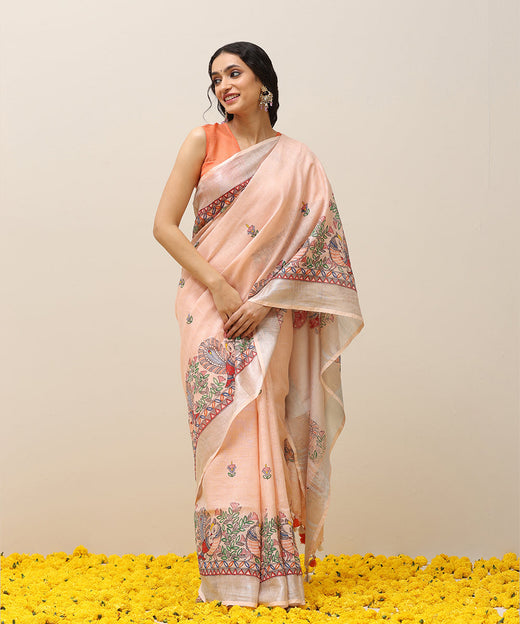
For example, a saree such as the Light Peach Handloom Linen Handpainted Madhubani Saree With Peacock Motifs and Silver Tissue Border - Pre Order already carries considerable visual detail, so a restrained blouse and jewellery can create a balanced look.
For a more traditional motif-focused appearance, the Handloom Light Peach Chanderi Madhubani Saree with Handpainted Fish Motifs in Black Ink - Pre Order allows the fish artwork to remain the central visual feature.
How Do You Care for a Hand-Painted Madhubani Saree?
Hand-painted textiles deserve careful handling.
Follow these basic practices:
-
Follow the care instructions supplied with the saree.
-
Avoid unnecessary friction on painted areas.
-
Store the saree carefully when not in use.
-
Keep it protected from prolonged moisture.
-
Use professional cleaning where recommended.
-
Store it in a breathable fabric such as muslin when advised. For silk pieces, our guide on how to store silk sarees covers folding and long-term protection.
WeaverStory recommends dry cleaning its Madhubani sarees and storing them in muslin cloth to help preserve their colours and hand-painted details.
WeaverStory's Approach to Madhubani Art
At WeaverStory, the focus is on connecting traditional craftsmanship with contemporary wardrobes. The Madhubani collection is created by women artisans from Mithila, Bihar, under the mentorship of a National Award-winning Madhubani artist. The sarees are produced in small batches and use handwoven fabrics including linen and Chanderi.
The collection reflects the diversity of the craft through different motifs, fabrics and colour palettes. For instance, the Handloom Fresh Green Chanderi Handpainted Madhubani Saree With Multicolor Women Motifs - Pre Order brings the artwork into a fresh, colourful palette, while the Lavender Handloom Chanderi Madhubani Saree With Elephant Motifs Handpainted on the Border - Pre Order gives the traditional elephant motif a refined textile setting.
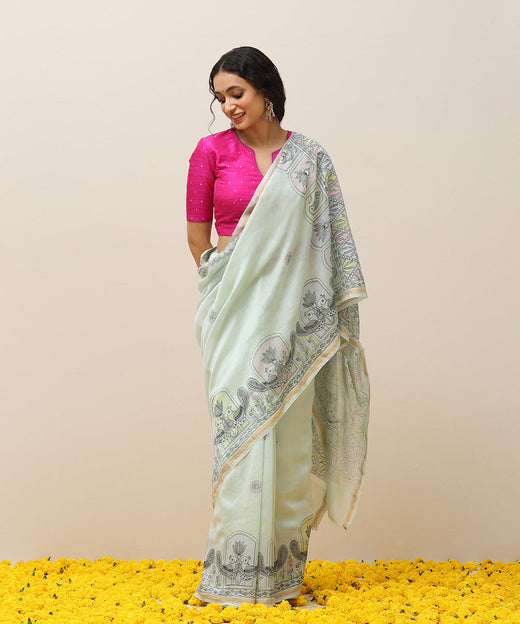
For a more understated look, the Handloom Offwhite Linen Saree With a Handpainted Madhubani Border in Red - Pre Order places the artwork along the border, creating a balance between natural fabric texture and hand-painted detail.
These pieces demonstrate how a traditional art vocabulary can move naturally into contemporary handloom fashion without losing its handcrafted character.
Experience the Art of Madhubani With WeaverStory
A Madhubani saree is not simply a garment decorated with traditional motifs. It is a meeting point between Mithila's artistic heritage, handloom craftsmanship and the patient work of artisans.
When you understand how the lines are drawn, colours are layered and patterns are built by hand, the saree becomes more than a beautiful drape. It becomes a wearable expression of a living craft tradition.
Discover WeaverStory's curated collection of hand-painted Madhubani sarees and explore pieces created with handwoven fabrics, intricate motifs and artisan-led craftsmanship. From peacocks and fish to elephants and floral compositions, each design offers a different interpretation of Mithila's visual heritage.
Explore WeaverStory's Madhubani Saree Collection and find a piece that brings this remarkable art tradition into your wardrobe.
Frequently Asked Questions
Q1. What Is Madhubani Painting?
Madhubani painting is a traditional folk-art form associated with the Mithila region of Bihar. It is known for bold outlines, vibrant colours, intricate patterns and motifs inspired by nature, mythology and cultural traditions.
Q2. How Is Madhubani Painting Done on a Saree?
The artisan prepares the fabric, plans the composition, outlines the motifs, fills them with colour and adds fine internal patterns. The completed artwork is then carefully finished and checked.
Q3. Can Madhubani Painting Be Done on Any Saree Fabric?
Madhubani artwork can be adapted to different textiles, but the fabric's texture, weight and finish affect the painting process and final appearance. Chanderi, linen, Tussar and cotton are among the fabrics used for Madhubani sarees.
Q4. Is a Madhubani Saree Always Hand-Painted?
No. Madhubani-inspired sarees can also be printed. A hand-painted saree is individually worked on by an artisan, while a printed saree reproduces the design mechanically or digitally.
Q5. Will Every Hand-Painted Madhubani Saree Look Exactly the Same?
No. Small differences in lines, colour application and motif detailing are natural in handmade artwork. These variations can contribute to the individuality of each piece.
Q6. What Is the Origin of Madhubani Saree Art?
The tradition originates in the Mithila region of Bihar, where Madhubani-style paintings were traditionally created on walls and floors. The art later expanded to paper, canvas and textiles, including sarees.
Q7. Why Is Madhubani Painting Important?
Madhubani painting preserves a distinctive regional artistic tradition while supporting the continuation of artisan skills. Its motifs, techniques and storytelling connect contemporary textiles with the cultural heritage of Mithila.
Q8. Can Madhubani Sarees Be Worn for Weddings?
Yes. Detailed Madhubani borders, pallus and motifs can work beautifully for weddings, festivals and cultural occasions. The choice of fabric and styling can make the saree either understated or more festive.